

Multi-line text content element
Rich text content can be parsed after binding data HTML language content
Vertical Overhung Magnetic Pump replace Teikoku,Nikkiso,Hermetic brand pump
Vertical Overhung Magnetic Pump API 685 is an unsealed centrifugal pump used in the petroleum, heavy chemical, and natural gas industries for highly toxic/carcinogenic/environmentally hazardous media Product attributes: Maximum head :>150m Maximum fiow:>400L/min Driving type:Motor Working impeller number:Single-Stage Pump Working impeller inlet way:Single Suction Pump Pump shaft positon:Vertical Pump Transportation package:Wooden Case Specification:API 685 standard Origin:Dalian,Liaoning,China
Key words:
horizontal multistage pump
Classification:
Product Description
Vertical Overhung Magnetic Pump
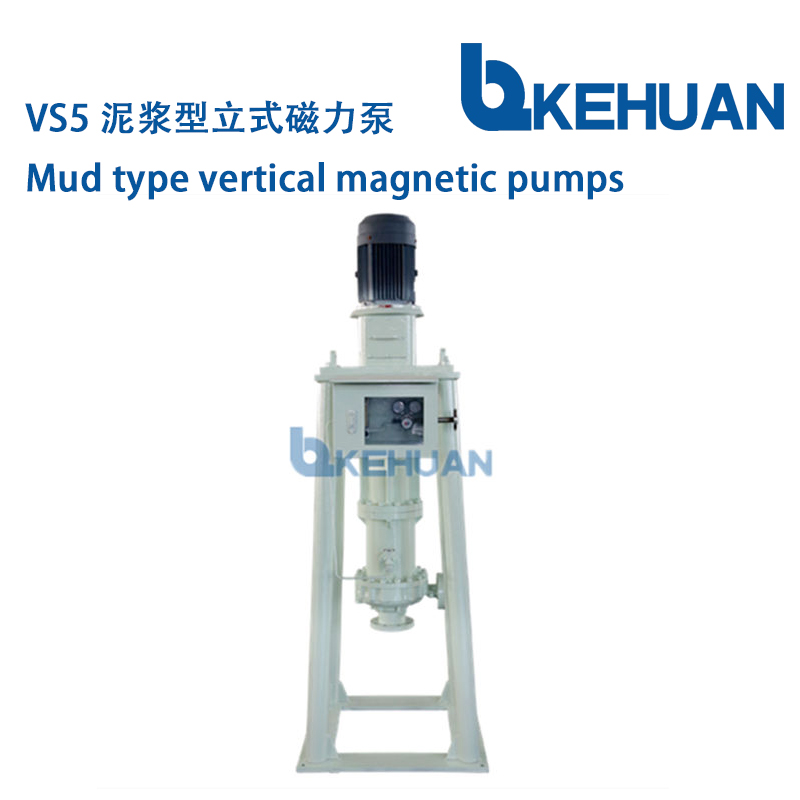
Product attributes:
Maximum head :>150m
Maximum fiow:>400L/min
Driving type:Motor
Working impeller number:Single-Stage Pump
Working impeller inlet way:Single Suction Pump
Pump shaft positon:Vertical Pump
Transportation package:Wooden Case
Specification:API 685 standard
Trademark:Dalian Kehuan Pump Co.,Ltd
Origin:Dalian,Liaoning,China
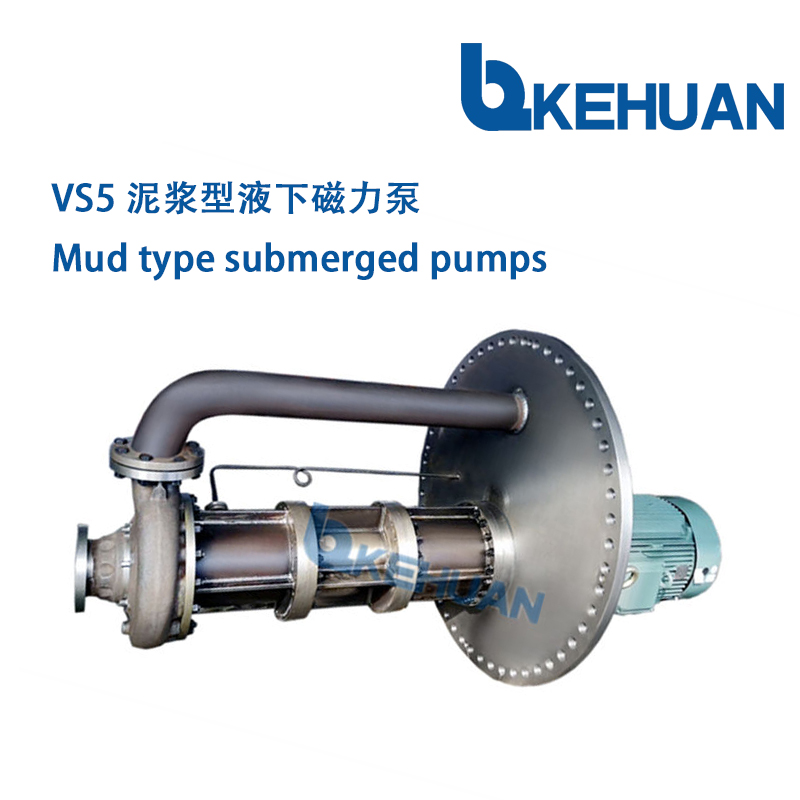
Structural features:
*Single stage, single suction, cantilever structure.
*Vertical installation, closed impeller or open impeller.
*The pump casing thickness is thickened and the abrasion allowance is large.Add cooling or heating jacket according to working conditions.
*The rotor housing is filled with inert gas to prevent impurities from entering, and it can be dry running, maintenance costs are very low.
Application:
It is suitable for conveying medium with large amount of solid particles, high abrasiveness and high melting point.
Material:
Carbonsteel; chromed steel; austeniticstainlesssteel; duplexsteel; Titanium and Titanium Alloys; Hastelloy C-276 and other special materials; It depends the customer's request.
| PARTS NAME | S-6 | A-8 | D-1 | TITANIUM | HAST C276 |
| Casing | Cast steel | 316 AUS | DUPLEX | Ti | HAST C |
| Impeller | 12%CR | 316 AUS | DUPLEX | Ti | HAST C |
| Containment shell | Hastelloy C276 | Hastelloy C276 | Hastelloy C276 | Hastelloy C276 | Hastelloy C276 |
| Inner magnet rotor | 304/SM2C017 | 316/ | 316/ SM2C017 | Ti /SM2C017 | HAST C/ SM2C017 |
| Pump shaft | 12%CR | 316 AUS | 2205 | Ti | HAST C |
| Slide bearing | 304/SSIC | 316/SSIC | 316/SSIC | Ti/SSIC | HAST C/SSIC |
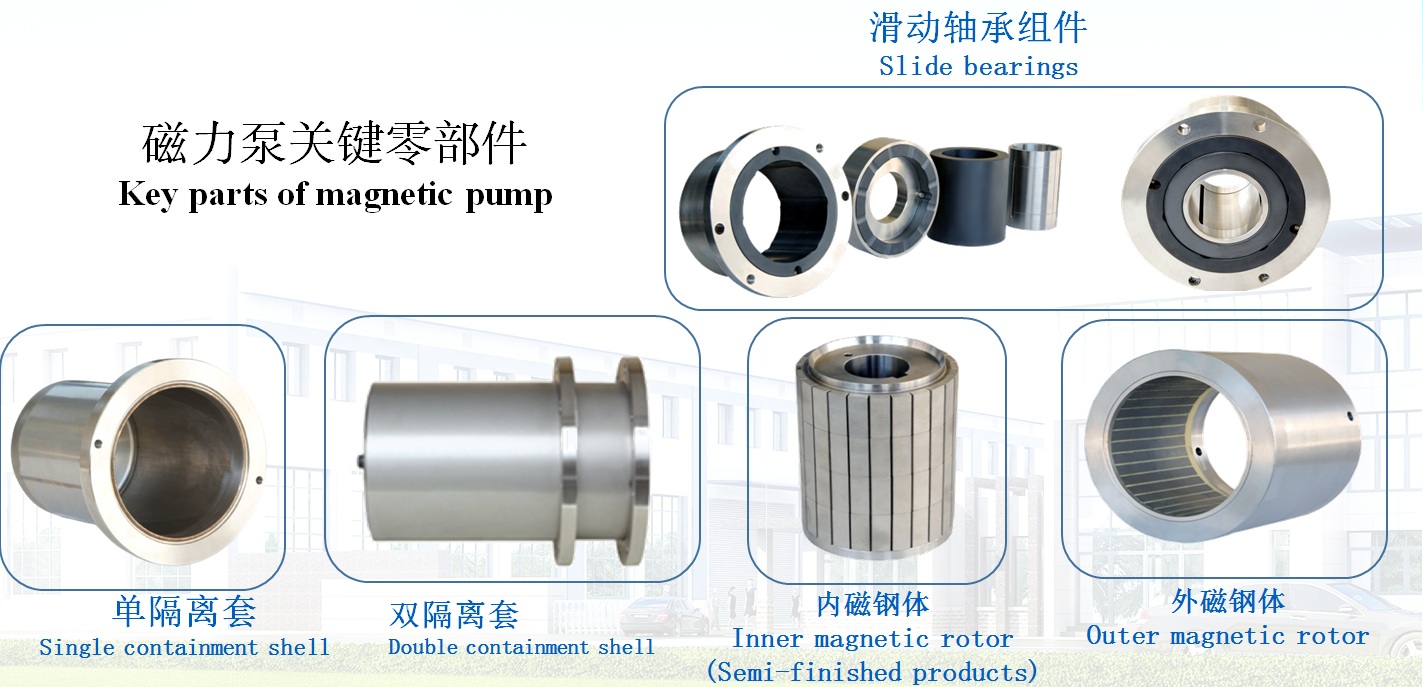
Containment shell
The containment shell is made fromHastelloy c-276formed by special technology without axial welding seam. So it ensures the sealing and chemical stability for containment shell
The double layer of containment shell functions reliable double protection. It will be alarmed when the first layer of containment shell is leaked while the medium is still completely
sealed without any leakage.
Slide bearing
The material of slide bearing is made from 97.5% purity rate of silicon carbide (SSIC),The working life of the wear resisting and high strength material is 10 times of normal silicon
carbide baring and carbon bearing.
Ball bearing
The ball bearing is NSK or SKF bearings.
Lubrication: Grease or Oil, It depends the customer's request.
Magnetic material
The magnet material of Kehuan magnetic pump is permanent-magnet alloy with unidirectional temperature up to 450oc. It is a medium to pass on the moment of torsion in magnetic
driven pump. It guaranteed a wide operating range and is highly resistant against demagnetization.


The core difference between API 610 and API 685 is that the former is the "standard for pumps with mechanical seals that pose a risk of leakage", while the latter is the "standard for pumps with zero leakage that are completely unsealed". The relationship between the two is not substitution, but parallel specialized standards for different hazardous levels of working conditions.
The following system comparison based on authoritative sources is conducted from five dimensions: standard positioning, sealing form, applicable working conditions, performance boundaries, and maintenance characteristics:
1、 The fundamental difference between core definition and standard positioning
Comparison Dimension API 610 API 685 Source
Standard full name: Centrifugal pumps for petroleum, heavy chemical and natural gas industries, unsealed centrifugal pumps for petroleum, heavy chemical and natural gas industries
Year of Publication: Eighth Edition, 1995 (now 12th Edition) First Edition, October 2000
Core definition of centrifugal pump standard with mechanical seal, covering OH/BB/VS full spectrum unsealed pump standard, only covering magnetic pump (MDP) and shielded motor pump (CMP)
Standard nature parent standard - covering the entire industry and spectrum of centrifugal pump basic specifications/parallel standards - specialized specifications for unsealed technology
Design philosophy controls leakage through high reliability mechanical seals and seal support systems to completely eliminate dynamic sealing points structurally and achieve zero leakage
The benchmark standard for API 610 relationship is the "unsealed version of API 610 equivalent standard"
Authoritative conclusion: API 685 is a parallel proprietary standard of API 610 in the specific branch of "unsealed technology", and is not a substitute relationship. Both are maintained separately by the American Petroleum Institute and are suitable for different levels of hazardous conditions.
2、 Genetic level differences in sealing form and leakage risk
This is the source of all differences and the most uncompromising selection red line:
Comparison Dimension API 610 API 685 Source
The shaft seal form is dynamic mechanical seal (single end face/double end face/series connection), and there is no dynamic seal when the shaft penetrates the pump casing - magnetic coupling penetrates the isolation sleeve, or the motor rotor is immersed in the medium
There is a possibility of leakage and a risk of leakage - the seal is a worn part, statistically the primary cause of pump failure. The structure has zero leakage - there is no shaft seal point, theoretically no leakage path
The sealing support system must be equipped with - API 682 sealing flushing scheme (Plan 11/13/23/32/53A/53B/54, etc.) completely unnecessary - no sealing, no buffer tank, cooler, filter, pressure boosting system required
Secondary containment non-standard configuration - usually relying on mechanical seals+seal support system optional/mandatory configuration - secondary containment must be equipped for high-risk media, as detailed in Annex P
There is a risk of fluid contamination - double sealing requires buffering/blocking liquid, which may contaminate the process medium. Zero contamination - no external fluid enters the process side
Engineering meaning: API 610 pumps always have a "dynamic sealing point", which is determined by physical laws. API 685 structurally eliminates this point - the fundamental and irreconcilable technical divergence between the two.
3、 The watershed between applicable working conditions and medium capacity
It's not who is better, but who "must use"/who "cannot use":
✅ Mandatory application scenarios and restricted areas of API 685 (unsealed pump)
Specific limitations/requirements for the applicability of API 685 in terms of operating conditions, including information sources
Medium hazard ✅ Absolute advantage - highly toxic, carcinogenic, strict VOC control, and zero leakage of strong environmental hazards are the only acceptable solutions; COSHH H Group I-IV substances require secondary contact
Purity of the medium ❌ Severely restricted - not suitable for media containing solid particles: particle size>0.1mm, content>5% wt, hardness>700HV
medium temperature ❌ Restricted - Curie temperature limit for magnetic steel neodymium iron boron: -40~120 ℃; Samarium cobalt: -40~250 ℃; Not available beyond this range
medium viscosity ❌ Restricted - Specific limits for torque loss and heat dissipation deterioration caused by high viscosity are not unified, but it is recognized that they are not suitable for high viscosity fluids
Stability of medium composition ❌ Restricted - with frequent changes in composition and poor adaptability, magnetic pumps are more sensitive to changes in medium properties
Maximum flow rate ❌ Restricted - not suitable for large-scale fluid transportation. Power typically<100kW, speed ≤ 3600rpm
✅ Advantages reserve area of API 610 (mechanical seal pump)
Specific Capability Information Source for API 610 Applicability in Operating Condition Dimensions
High traffic/high power ✅ Absolute advantage without power limit, single-stage flow can reach 10000m ³/h+
High temperature medium ✅ Absolute advantage -112~400 ℃+(special design can reach higher)
high pressure ✅ Absolute advantage discharge pressure ≤ 15MPa (G) (BB5 can reach even higher)
Containing solid particles ✅ Can handle through hard sealing surface and flushing scheme design
high viscosity ✅ Can handle through sealed chamber design and flushing scheme
The composition of the medium is variable ✅ Strong adaptability through replacement of sealing materials/model adaptation
Selection red line:
Highly toxic/carcinogenic/strong environmental hazardous media → must comply with API 685 (API 610 is not accepted)
High flow rate/high temperature/particle content/high viscosity → API 610 is required (API 685 is not applicable)
4、 Performance, efficiency, and energy consumption characteristics
Comparison Dimension API 610 API 685 Source
Efficiency level benchmark: High efficiency is usually 5-10% lower - magnetic coupling eddy current loss, air gap loss
Low power consumption and high power consumption - a larger motor is required for the same hydraulic output
Speed limit can reach higher (high-speed pump OH6), typically ≤ 3600rpm
The upper limit of power has no theoretical limit and is limited by the torque transmission capacity of the magnet steel (typically<400kW)
The vibration level has strict limits (API 610 requirements), and the design requirements are similar, but there is no issue of seal wear
Engineering meaning: API 685 uses "energy consumption for safety". In scenarios where zero leakage is necessary, energy consumption is an acceptable cost.
5、 Maintainability, lifespan, and failure modes - completely opposite philosophies
Comparison Dimension API 610 API 685 Source
Maintaining the mechanical seal of the center of gravity - with the highest failure rate and requiring predictive maintenance of bearings (sliding bearings) - with medium lubrication and invisible wear
Progressive fault warning - early detection of trace leaks in the seal - sudden failure of bearings or magnetic couplings often without warning, direct shutdown
The consequences of the malfunction are controllable - seal leakage, planned maintenance may be catastrophic - isolation sleeve rupture/demagnetization/bearing locking, high maintenance costs
High on-site repairability - low on-site replacement of seals and bearings - usually requires return to the factory or professional workshop
Monitoring requirements optional (vibration, temperature) mandatory - API 685 requires bearing wear monitoring and isolation sleeve temperature monitoring
The design lifespan is ≥ 3 years of continuous operation, and the entire machine is ≥ 20 years as required by API standards
Engineering meaning: API 610 is predictable and repairable; API 685 relies on "prevention in advance" - a monitoring system must be configured, otherwise the operation will be blind box.
6、 Spectrum coverage and design freedom
Comparison Dimension API 610 API 685 Source
Complete coverage of pump types - OH1~6, BB1~5, VS1~6, all series limited - only OH2, BB2, vertical pipeline pump (partial), vertical multi-stage (Annex Q)
VS vertical suspension pump fully covered (VS1-VS6) currently not covered (API 685 text does not include VS type, only Annex Q involves partial multi-stage vertical)
High design freedom - limited by various materials, bearings, lubrication, and cooling schemes - restricted by magnetic steel, isolation sleeves, and sliding bearings
Couplings must be metal flexible, with a middle extension joint, API 671 magnetic pump: with couplings (outer magnetic steel+inner magnetic steel); Shielded pump: without coupling
Key note: API 685 is not as simple as the "unsealed version" of API 610- it currently does not cover VS1-VS6 vertical suspension pumps (which is the exclusive domain of API 610), and only partially covers multi-stage pumps in the form of an appendix.
7、 Systematic differences in cost structure
Comparison Dimension API 610 API 685 Source
The initial procurement cost benchmark is relatively high - magnetic materials, precision machining, isolation sleeves
The cost of the sealing support system includes - API 682 sealing flushing system, buffer tank, cooler, etc. - zero - no need for any sealing auxiliary system
High installation cost - large footprint, complex piping, low need for alignment - compact, no need to seal system piping
Low operating energy consumption cost and high efficiency -5-10% lower
Medium maintenance cost - regular replacement of seals may be higher - high cost of repairing a single malfunction
Low load operating conditions have advantages over high-risk medium operating conditions (avoiding leakage costs) throughout the entire lifecycle cost
Engineering meaning: API 685 converts "investment in sealing support system" into "investment in magnetic drive system", saving land occupation and installation time. For high-risk media, this is a mandatory cost; For conventional media, economic accounting is required.
8、 Standard trigger threshold (when must it be raised from 610 to 685?)
API recommendation: When the operating conditions exceed any of the following parameters, API 685 should be considered/recommended:
Parameter threshold
Discharge pressure>1900 kPa (275 PSI)
Inhalation pressure>500 kPa (75 PSI)
Pumping temperature>150 ° C (300 ° F)
Speed>3600 rpm
Rated head>120 m (400 ft)
Impeller diameter>330 mm (13 in)
But please note: this is not a forced conversion line, but a "recommended consideration" line. The real mandatory use of API 685 is the medium hazard, not the parameters themselves.
9、 Summary Comparison Table (One click Decision)
Choose API 610 as the decision dimension and API 685 as the source of information
Highly toxic/carcinogenic/strict control of VOCs in the medium ❌ unacceptable ✅ Forced selection
The medium contains solid particles ✅ applicable ❌ Not applicable (>0.1mm/5% wt)
Medium temperature>250 ℃ ✅ applicable ❌ Not applicable (magnetic steel limit)
Medium with high viscosity ✅ applicable ❌ Not applicable
High flow rate (>500m ³/h) ✅ applicable ❌ Not applicable
Power>200kW ✅ applicable ❌ Not applicable (torque limit)
Weak maintenance force/on-site repair requirements ✅ Advantage (easy to replace seal) ❌ Disadvantage (return to factory)
Extremely limited space/offshore platform ❌ Disadvantage (sealing system takes up space) ✅ Advantage (Compact)
Extremely high requirements for fluid purity ❌ There is a risk of pollution (double sealed) ✅ Zero pollution
Budget sensitive/LCC conventional working conditions win, high-risk media win
Final conclusion:
API 610: The universal mainstay of petrochemicals, covering over 95% of working conditions, reliable, efficient, and easy to repair, but always with the risk of leakage.
API 685: For special forces targeting high-risk media, it has zero leakage and zero pollution, but has usage boundaries (no particles, medium low temperature, medium and small power), and faults are more sudden and maintenance is more difficult.
The two are not in a competitive relationship, but rather a division of labor between the "conventional forces" and the "chemical defense forces". The only correct method for selection is to first check if the medium is high-risk (must be 685), and then check if the parameters are within the 685 capability boundary (otherwise, only strict sealing management can be achieved with 610+).
Structural characteristics and application industries of HERMETIC vertical magnetic pump
I have read 10 web pages
Like the HERMETIC shielded pump you previously learned about, HERMETIC is also a global technology leader in the field of magnetic pumps. As a German company founded in 1866, HERMETIC focuses on the research and manufacturing of leak free magnetic drive pumps, and has strong competitiveness in the field of high-end and special application pumps. Its Chinese joint venture company, Dalian Haimitike Pump Industry Co., Ltd., was established in 1997 by HERMETIC from Germany and Danai Pump Industry. It is the only domestic enterprise that can simultaneously master API 685 shielded pump and magnetic pump technology.
Below is a detailed analysis of the structural characteristics and application industries of HERMETIC vertical magnetic pumps.
🛠️ Structural characteristics of HERMETIC vertical magnetic pump
HERMETIC magnetic pump and shielded pump are both leak free pumps, but their technical paths are different: magnetic pumps transmit torque through magnetic couplings to achieve "static sealing" instead of "dynamic sealing". HERMETIC's vertical magnetic pump inherits the universal advantages of magnetic pumps and incorporates multiple German engineering features.
Overall structure
Characteristics and Description of Structural Components HERMETIC Technology Features
The overall layout is a vertical structure, with the pump body and motor connected by a magnetic coupling, and no rotating shaft seal device, achieving "zero leakage". Vertical design is particularly suitable for conveying low viscosity media, ensuring the service life of bearings.
The magnetic coupling adopts high-quality rare earth permanent magnet materials, with a maximum irreversible annealing temperature of 350-400 ℃, ensuring stable performance. Permanent magnets have high stability and can prevent adverse effects during assembly, disassembly, or operation at maximum torque transmission.
The drive shaft of the bearing system is supported by rolling bearings (lubricated with grease); The pump shaft is supported by hydraulic sliding bearings. Sliding bearings are directly lubricated and cooled by the conveying medium, without the need for external lubricating oil and cooling water systems.
During axial force balancing operation, the axial force is automatically balanced by hydraulic pressure, and the pushing plate only experiences instantaneous axial thrust during start-up and shutdown. This design greatly reduces bearing wear and extends the operating life of the pump.
There is an isolation sleeve between the inner and outer magnetic steel of the isolation sleeve magnetic coupling, which completely seals the medium inside the pump chamber. Cooling by the conveying medium should prevent scratches or punctures caused by hard particles.
Core technology: Vertical design suitable for low viscosity media
HERMETIC has an important technical consideration in vertical magnetic pumps: for low viscosity media, a vertical structure needs to be selected to ensure the service life of the bearings. This is because:
Low viscosity media (such as water, solvents, liquefied gases, etc.) have poor lubricity
The vertical structure can utilize gravity to ensure that the bearing area is always filled with medium
Ensure that the sliding bearings receive sufficient lubrication and cooling to prevent dry wear damage
Special design: prevents bearing wear during shutdown
HERMETIC has adopted an innovative design to address the issue of bearing wear during the shutdown and restart of vertical pumps: a set of mutually repulsive magnetic rings are installed at the balance plate to ensure that the dynamic and static rings of the balance plate do not come into contact and repel each other during equipment shutdown, greatly extending the bearing life.
Typical performance range (based on Dalian Haimitick product line)
Parameter Range
There are 21 product series and 440 varieties, covering two major product lines: shielded pumps and magnetic pumps
The product type can provide magnetic pumps that comply with API 685 standards
Qualification certification has passed ISO9001, ISO14001, OHSAS18001 certification, and obtained the design and manufacturing license for civil nuclear safety equipment
Participated in drafting industry standards such as the "Technical Specification for Unscented Centrifugal Pump Engineering in Petrochemical Industry"
🏭 The application industry of HERMETIC vertical magnetic pump
With its core advantage of "zero leakage" and German quality, HERMETIC magnetic pumps are widely used in fields that require extremely high safety and reliability:
Petroleum Refining and Petrochemical Industry
Typical application: Transporting flammable, explosive, toxic, corrosive hydrocarbon media (gasoline, diesel, aromatics, alcohols, ketones, etc.)
Core advantage: Completely leak free, compliant with API 685 standard, successfully solving the problems of running, emitting, dripping, and leaking in fluid transportation
Application achievements: Sinopec Jiujiang Petrochemical 80000 tons/year ethylbenzene styrene plant, Uzbekistan Navoi PVC and other projects
Chemical and Fine Chemicals
Typical applications: Transporting highly corrosive acids, bases, solvents, catalyst slurries, etc
Core advantage: Suitable for transporting corrosive, toxic, flammable, explosive, expensive, or easily vaporized liquids
Application achievements: BASF (Shanghai, Nanjing, Shenyang, Jilin), Yangzi Petrochemical, Shanghai Baosteel, Jinshan Petrochemical, DuPont, Bayer and other well-known enterprises in the United States
New Energy and Coal Chemical Industry
Typical application: Medium transportation in methanol to olefin and coal to olefin projects
Core advantage: Submersible magnetic pump meets the strict requirements of low cavitation allowance
Nuclear Power and Energy
Typical application: Nuclear three-stage pump, used in projects such as "Hualong One"
Core advantage: Breaking the dependence on imported shielding pumps for nuclear power and achieving localization of key equipment
Refrigeration and Air Conditioning
Typical applications: transporting refrigerants, heat medium oils, etc
Core advantage: The preferred refrigeration medium liquid transfer stability tool for global refrigeration supporting enterprises
Medicine and Textile
Typical applications: transporting medicinal liquids, chemical raw materials, etc
Core advantage: No leakage ensures cleanliness and meets GMP requirements
Other application areas
Rail transit: used for special applications such as locomotive pumps
Low temperature application: suitable for transporting high temperature, low temperature fluids, and liquids in vacuum state
Semiconductors and Electronics: Transporting High Purity Chemical Reagents
💎 HERMETIC Magnetic Pump vs. Shielded Pump: Technical Comparison
Based on your previous understanding of HERMETIC shielded pumps, here we will compare the main characteristics of magnetic pumps and shielded pumps:
Comparison dimension magnetic pump shielded pump
The transmission method transmits torque through a magnetic coupling, and the motor and pump are separated. The motor and pump are integrated, and the rotor directly drives the impeller
Motor type standard motor (replaceable, easy to maintain) dedicated shielded motor (both stator and rotor are sealed inside the pump)
Slightly higher efficiency (no shielding sleeve eddy current loss) and slightly lower efficiency (shielding sleeve generates eddy current loss)
Suitable for medium cleaning or liquid cleaning liquids containing small amounts of particles (particles can cause wear on the shielding sleeve)
Maintenance features: The motor can be repaired separately, and the bearings are lubricated by the medium. The motor and pump are integrated, and maintenance requires overall disassembly
All common advantages have achieved "zero leakage", meeting the API 685 standard and achieving "zero leakage", meeting the API 685 standard
Are you selecting a specific low viscosity medium, liquefied gas, or high-temperature working condition, or would you like to further understand the technical differences between HERMETIC magnetic pumps and TEIKOKU and NIKKISO products discussed earlier? Tell me your specific situation, and I will help you analyze it further.
Related Business


You are welcome to consult with us on our products
Contact Information
Xiajiahe Village, Ge Zhen Bao Street, Ganjingzi District, Dalian City (Golf)
Quick Navigation
Copyright©2023 Dalian No.1 Corrosion Resistant Pump Factory
Right online agent component